
 Rob
Rob 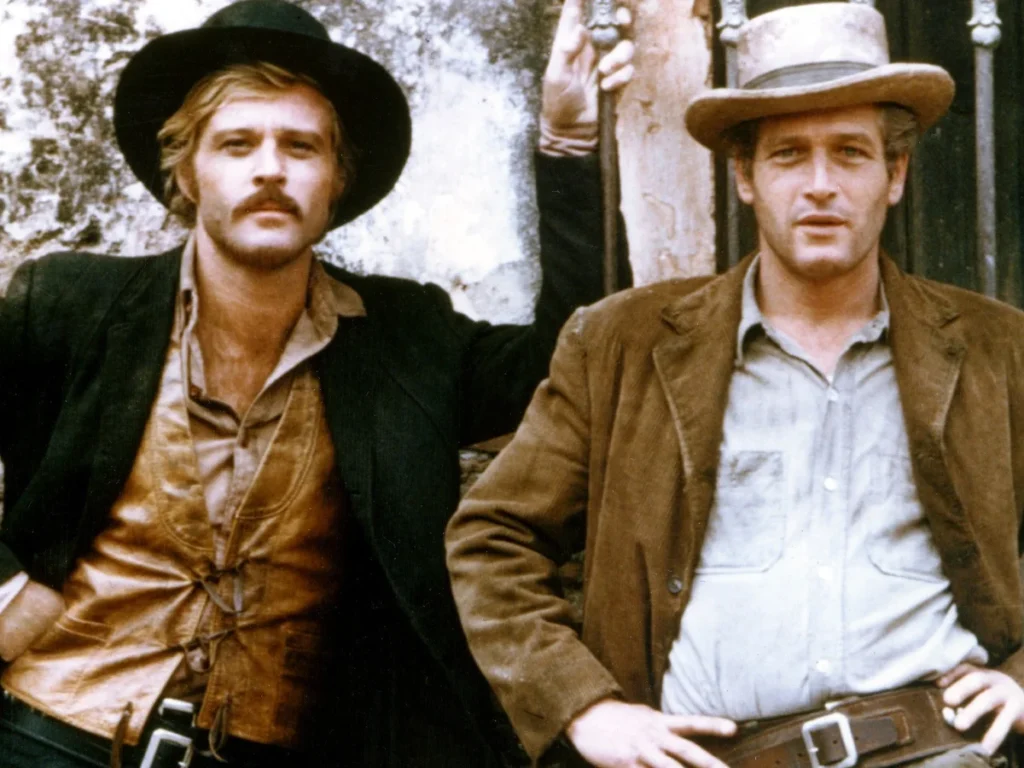
Butch Cassidy and the Sundance Kid has always been a favourite film of mine. I was first introduced to it as a child, and it has remained one of those films that I have enjoyed re-watching time and again over the years.
Released in 1969 and starring Paul Newman and Robert Redford, it is a Western that tells the story of two outlaws who are part of the Hole-in-the-Wall gang, known for committing a string of bank and train robberies. They end up on the run from an elite posse of US detective agents, eventually fleeing the country and heading to South America, before finally meeting their demise in a shootout with the Bolivian Army.
The film is based on the true story of real-life outlaws, Robert LeRoy Parker (who came to be known as Butch Cassidy) and Harry Longabaugh, who acquired the nickname the Sundance Kid.
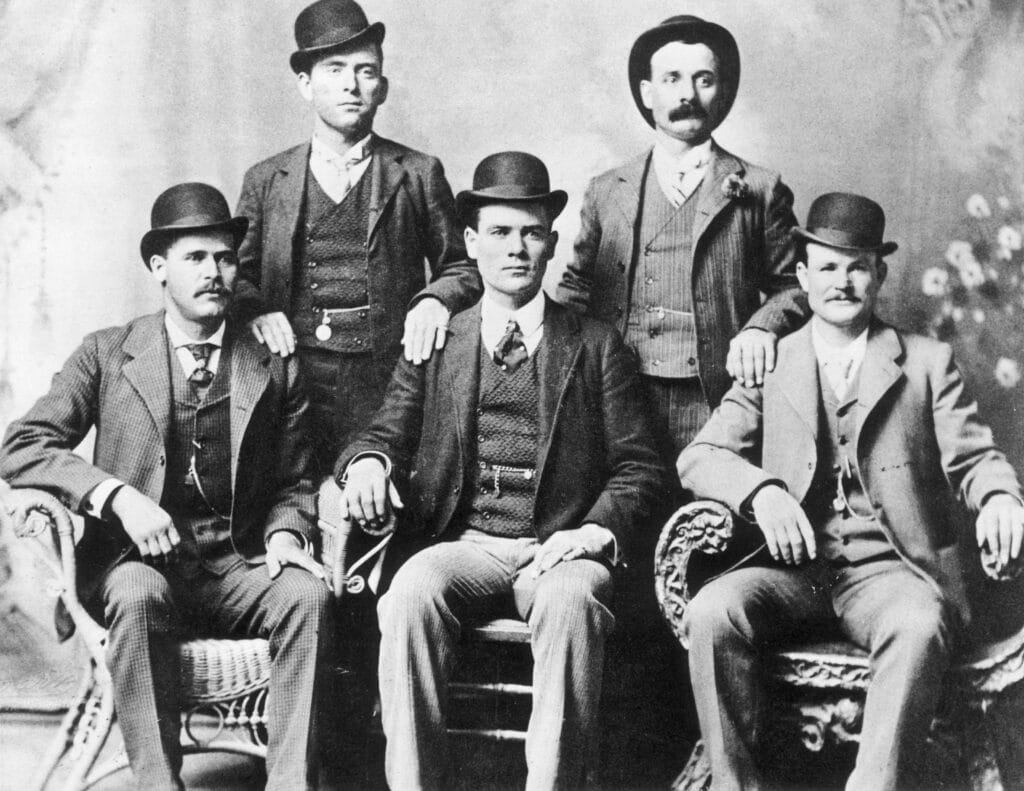
(A photo of the real-life Butch Cassidy (seated on the right) and the Sundance Kid (seated on the left) with some other members of the Hole-in-the-Wall gang)
Having decided to go travelling in South America myself and establishing that part of my itinerary would include visiting Bolivia, the film immediately popped into my head. It is such a family favourite of ours that both of my brothers and my dad also mentioned the film when I started providing details to them about my planned trip and they asked if I would be seeking out where Butch and Sundance met their fate.
Although Bolivia receives a fair number of travellers, it is arguably a little overlooked at times in comparison to some of its neighbours, such as Peru, which sees an abundance of tourism. Often, when I spoke to fellow backpackers on my journey, Bolivia was either being completely bypassed or they were taking a fleeting visit to the capital, La Paz, and maybe a trip to the Uyuni Salt Flats. Very few people, it turns out, were intending to explore the background to a popular Hollywood film.
When organising my route through Bolivia, the story of Butch Cassidy and the Sundance Kid was very central to my thoughts. However, it soon became apparent that it wasn’t at the forefront of the minds of the Bolivian tourism industry, just as it hadn’t been for the backpackers that I’d spoken to. A Google search revealed just one tourist agency, based in the town of Tupiza, that appeared to have a specific excursion they ran directly linked to the two outlaws. There was, however, an accommodation option in the town called the Hostal Butch Cassidy, which gave me enough hope to go ahead and book a room there and grab a ticket for a bus headed in that direction.
Tupiza is located in southern Bolivia and my bus journey there from Potosi took several hours. The town lies in a region of the Andes Mountains at an elevation of nearly 3,000 metres and is set amongst stunning desert landscapes and beautifully rugged red rock formations – the area is commonly known as Bolivia’s own Wild West. Its proximity to the Argentinian border means that it does receive a reasonable number of backpackers, who pass through here when either entering or leaving the country from the south and often use it as a stop-off to break up lengthy bus journeys or as the starting point for a multi-day tour heading to the Uyuni Salt Flats.
It was late evening by the time we pulled into the town’s small bus station but fortunately my accommodation was just a short walk away. The first thing I noticed about the hotel when I arrived was that other than the sign above the front door, there was not a single piece of memorabilia or artwork in the place designed to commemorate the story of the man after whom it was named. Despite my initial disappointment at this, I did at least have a relatively cheap and clean room to rest my travel-weary body.
The following day, my main mission was to get booked onto a tour so that I could re-live a little part of history of one of my favourite films. Further research confirmed that there was just one company in town that I would have to rely on who ran an excursion principally focused on the story of the demise of the two outlaws, although there were some options for doing trips on horseback in the area that mildly referenced Butch and Sundance. I headed to their tourist office, which was based inside the Hotel Mitru in town, and immediately saw that this was frequented by a number of backpackers, who I hoped would be as like-minded as me about wanting to follow in the footsteps of the two outlaws.
It soon became apparent that this would not be the case. There were no Butch Cassidy tours scheduled to take place, and nobody had apparently enquired about booking that particular tour for several weeks (at least!). The girl working in the office dealing with my request, Mariana, seemed genuinely surprised and excited that she had met somebody who was interested in the story and the tour. At one point she even rushed over to another desk in the office while we were in mid-conversation to alert her mother (who ran the business) to the situation and returned with a signed copy of a book investigating the lives of the bandits to show me.
The outcome was that I could take the tour the next day, but it would be expensive as I was the sole participant booked on and therefore costs for running the excursion rested with me rather than being shared amongst a party of people. I figured that, having come all this way specifically for this purpose, I would just have to bite the bullet and pay for a private tour.
To soften the blow to my wallet, Mariana made a few phone calls and was able to organise for me to visit a local resident of the town who is an enthusiast of the Butch and Sundance story and who has accumulated a haul of memorabilia over the years. Once he had finished his day job, Mariana escorted me to the house of the guy, called Felix, who proceeded to show me his impressive collection of photos and mementos from the period, as well as information he has been able to gather about the true story of the outlaws and what happened to them.
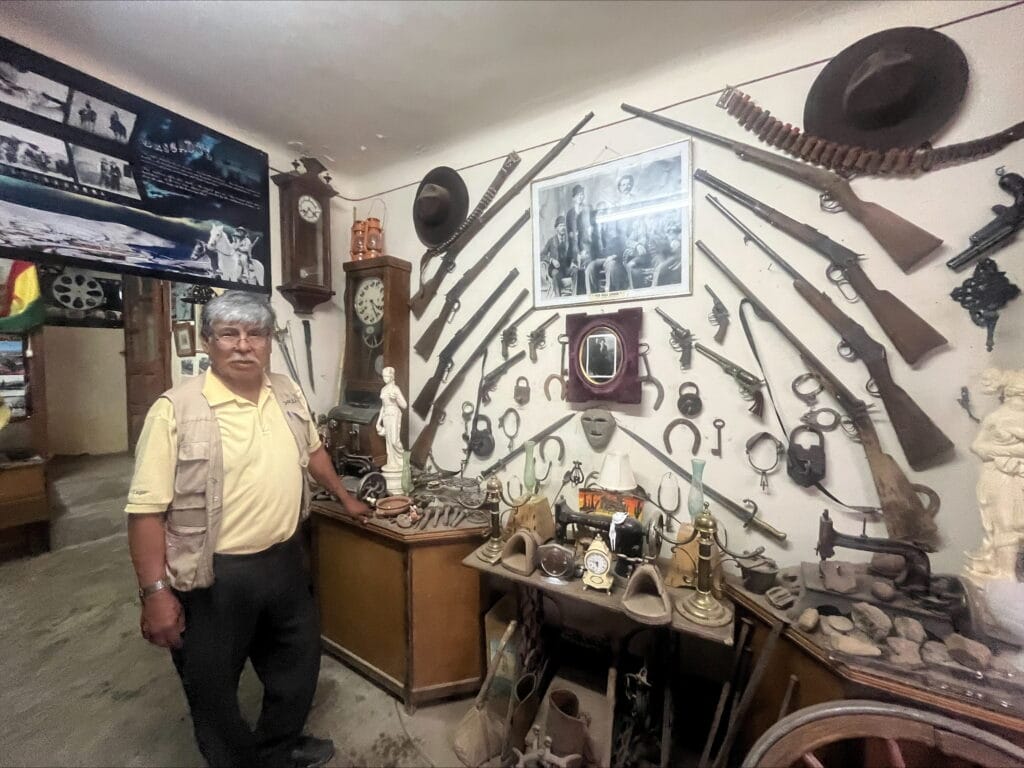
(Local resident of Tupiza and enthusiast of the Butch and Sundance story, Felix, showcasing his extensive collection of memorabilia from the period)
There are many tales and theories about the two bandits but what is known is that in early 1901, they fled New York City along with the Sundance Kid’s companion, Etta Place, on a steamship to Buenos Aires. The trio appear to have then settled into a law-abiding existence in Argentina for a period, purchasing a ranch in the Patagonia region, near a small town called Cholila. However, they sold the ranch after four years, possibly because US detectives had tracked down there whereabouts, Etta Place returned to America, and indications are that Butch and Sundance returned to their more familiar life of bank-robbing and by 1908 were living in Bolivia still hoping at some point to settle down as honest ranchers.
It is thought that the pair may have arrived in Tupiza on the premise of robbing the local bank in town. However, while here, they learned about a payroll being carried by mule for the workers at the nearby Aramayo Mining Company and they decided it was too good of an opportunity to miss. Having successfully performed a hold-up on the courier and stolen the payroll while he was on the way to delivering it to the mine, it seems that the luck of the two outlaws was soon to run out.
I set off from Tupiza the following morning with Eddie, who is my driver and tour guide for the day, heading for San Vicente, which is the alleged location that Butch Cassidy and the Sundance Kid met their downfall. It is a 100km drive to San Vicente from Tupiza, and while the scenery is beautiful, it is a desolate area and much of the journey is taken on bumpy, little-used roads. Back in 1908, on horseback, it was a 3-day journey for the duo across this barren and rugged terrain of canyons and desert-like landscape before they reached the small mining town of San Vicente seeking lodgings for the night.
When we eventually arrive in San Vicente, the place is somewhat underwhelming. This is still a fully functioning silver mine, operated by Pan American Silver and the only people on the site of the former town are employees. It takes us a few minutes at the main entrance showing the armed guard paperwork and our identification, as well as a phone call to the head office, before the gate is finally opened and Eddie can drive us into the fenced-off community.
Eddie parks up alongside the Plaza San Vicente and tells me that I am free to have a wander around for a few minutes while he speaks to the relevant authorities here to obtain access to the main sights of the tour.
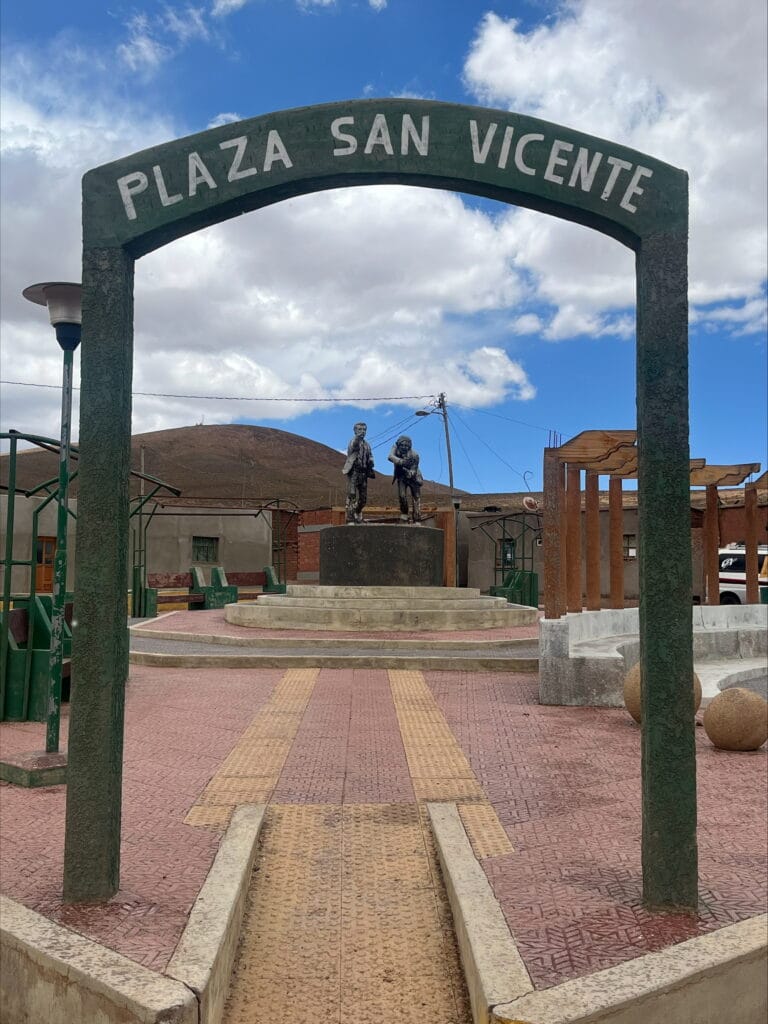
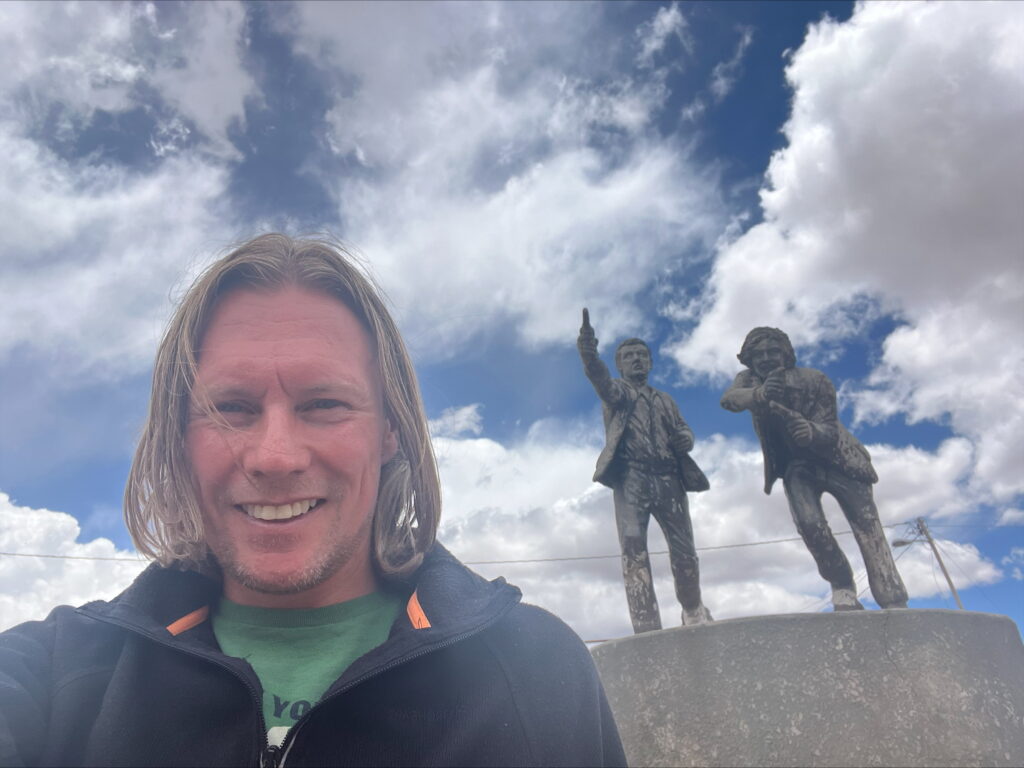
The small plaza is completely deserted, as are the small church and the couple of streets that surround it. Other than some park benches and a horseshoe of steps designed as a mini auditorium, the main focal point is a slightly dilapidated statue in the centre of the square depicting Butch and Sundance based on the final shot of the two from the Hollywood film. I take several photos of the statue and scour the properties around the plaza trying to imagine which of the buildings they may have taken refuge in when their final gunfight occurred. All the houses surrounding the square are simple, one-storey grey buildings fronted by a door and single window, and it is difficult to tell if any of them are occupied.
According to reports, the owner of the small boarding house that the duo was lodging in became suspicious of them when he spotted that a mule they had in their possession was branded with the name of the mining company that had been robbed. The man alerted a nearby telegraph officer, who notified a local cavalry regiment stationed in the area and a small unit was dispatched to San Vicente. The unit of soldiers, the police chief, the local mayor, and some other officials of the town allegedly surrounded the lodging house on the evening of 6 November 1908 in an attempt to arrest Butch Cassidy and the Sundance Kid. However, the outlaws opened fire on them and a gunfight ensued for several hours until around 2:00 am when the mayor of the town claimed he heard screams from inside the lodging house before two final gunshots in succession were fired.
I return to speak to Eddie, who is preparing our lunch of chicken salad and rice in the boot of the car. He tells me that we will soon be able to access the cemetery where it is believed the graves of Butch and Sundance are located but the mining company are having trouble trying to track down the person who is responsible for the key to the on-site museum, so he cannot confirm if I will be able to visit that as yet.
He also informs me that this is not in fact the original location of the town’s main square. The plaza and the surrounding properties were all built for the original residents much more recently as they had to make way for development and expansions being made to the silver mine. Eddie points to another area of the complex containing numerous offices, temporary huts, and some basic living quarters where the original main square used to be and adds that the museum is housed down there.
I turn back to look at the plaza with an air of disappointment – I have not been standing directly in the footsteps of the two outlaws as I first thought. I still get Eddie to take a couple of photos of me next to the statue though as we have some time to kill. He tells me that we have fifteen minutes until we will be visiting the cemetery, so I have another little wander and find a football pitch around the back of the street of houses. It is a dirt pitch, made up of sand and stones, and a single llama is loitering under one of the goalposts searching for any crumbs of vegetation it can find to eat. I kind of know how it must be feeling based on my own current struggle hunting for anything substantial.
Eddie gets a call, and we jump in the car to take a short drive over to where the town’s cemetery is located. We are met there by an employee of the mine, who unlocks the gates and allows us access into the walled cemetery. Inside, there are a mish mash of different sized and shaped headstones, some covered with dried flowers and religious mementos. Close to the centre stands a rather garish blue sign, the sort you might find being used as a road sign, simply saying, “BUTCH CASSIDY SUNDANCE KID” to indicate the alleged location of their graves.
Based on local police reports, on the morning after the gunfight, local authorities entered the lodging house and found the two bodies covered with numerous bullet wounds. Judging by the final resting positions of the bodies, they speculated that Butch Cassidy had shot the fatally wounded Sundance Kid in the forehead to put him out of his misery, before killing himself. Therefore, the final scene in the movie is almost certainly pure Hollywood dramatics.
Although the duo was identified as the men who had robbed the mining payroll courier, the authorities did not know their real names and had no way of positively identifying who they were. The unnamed bodies were therefore buried in the San Vicente cemetery, apparently close to the grave of a German miner, Gustav Zimmer, who had died in the town. However, a search for their graves at the cemetery in 1991 by a team investigating the story failed to find any remains containing DNA matching relatives of the pair of outlaws.
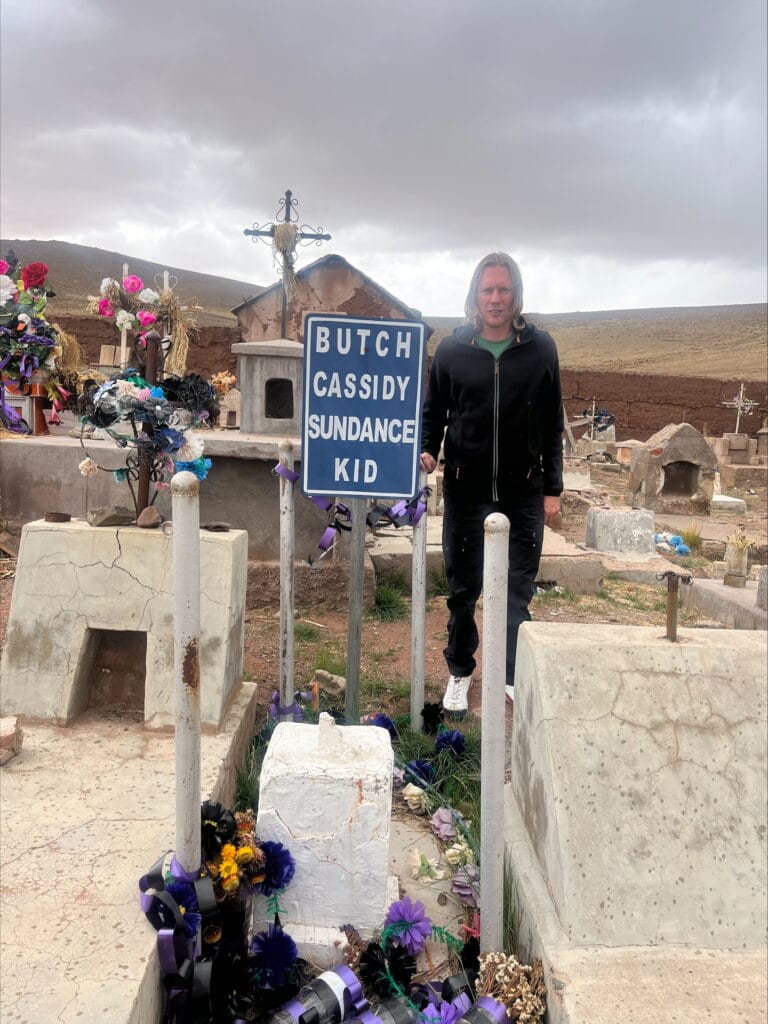
I still reluctantly allow Eddie to take a photo of me stood next to the awful sign marking their alleged but somewhat unconfirmed resting place.
Having received notification that the keys to the museum have now been located, we leave the cemetery and make our way towards the main confines of the mining headquarters and Eddie parks up in front of an unremarkable looking wooden hut. A female employee is waiting there to greet us and to let us into the building. She comments that I am the first visitor to the museum in a long time. A passing Pan American work colleague of hers fires a quick question in her direction and then, intrigued, pokes his head through the doorway and looks inside. Apparently, he wasn’t even aware that a museum existed on the site, so he decides to join us.
There is no offer (or need) for a guided tour of the museum – it is a small, single room hut, which is sparsely filled with memorabilia relating to Butch Cassidy and the Sundance Kid. I consider that the guy, Felix, back in Tupiza probably has a larger collection in his house than what I see before me. My colleagues stand just inside the doorway and watch on as in my own time I am left to wander around the room taking in the various items on display.
There are photos on the walls of the real-life bandits, as well as some of the actors taken from scenes of the Hollywood film. There is a ‘WANTED’ poster for Butch Cassidy produced by the Pinkerton National Detective Agency, the company that was appointed to capture the pair back in the United States, offering a $5,000 reward for the outlaw. There is a framed letter dated the day after the alleged gunfight in San Vicente that has an official stamp from local police officials. There is a framed newspaper cutting related to the story, as well as some framed Bolivian banknotes from the period.
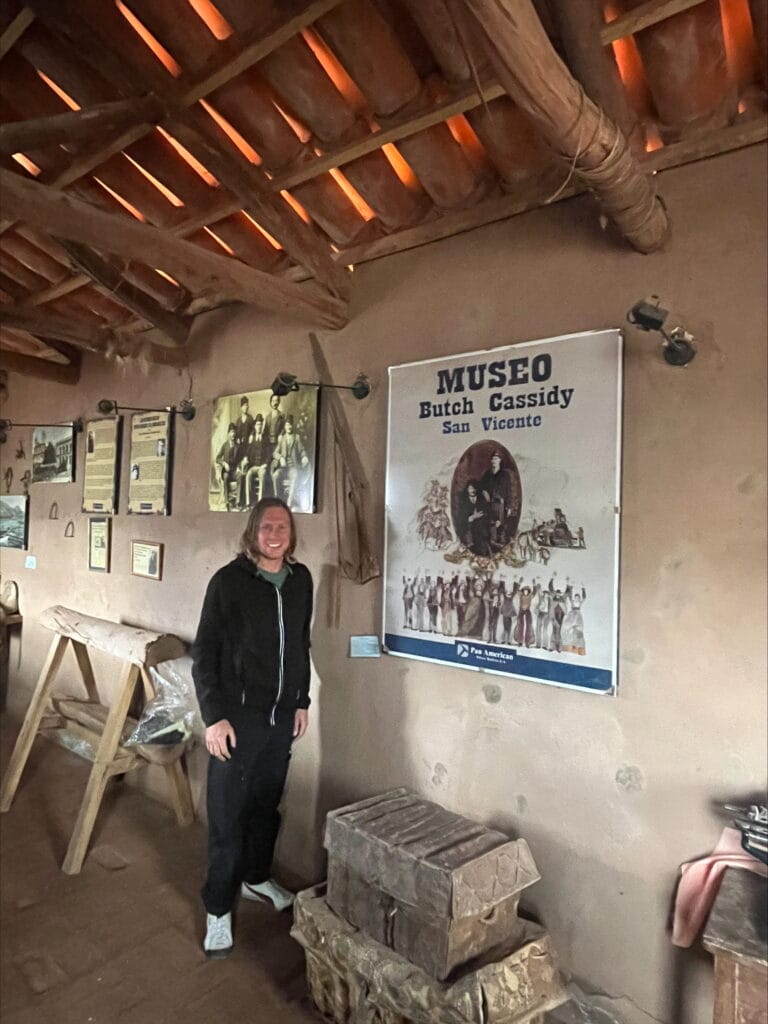
Some text briefly outlining the story of the two bandits is provided in the museum from Anne Meadows and Daniel Buck, who researched the outlaws time in South America and wrote the book, ‘Digging Up Butch and Sundance.’ There are saddles, rifles and other equipment from the time, as well as some hats from the era. I am convinced by my guide, Eddie, and the woman from the mining company into trying on one of the hats that is similar in design to what Butch Cassidy is wearing in one of his real-life photos. I am also persuaded into purchasing a neckerchief with Butch Cassidy and the Sundance Kid emblazoned on it as a memento of my trip here.
And with that, other than the drive back to Tupiza, the tour has finished and my unusual and unique search into the demise of Butch and Sundance in Bolivia is over.
Much like the many rumours that exist that the pair did in fact survive the gunfight and may have even returned to the United States later in life, there are many questions I have that are still very much unanswered. It is difficult to say with any certainty that I have followed in the footsteps of Butch and Sundance and visited their last resting place. However, this little adventure has certainly not robbed me of my interest and intrigue into the pair of outlaws, and I’m not yet shot of my love for the film or their story either.

 Rob
Rob